Showing posts with label Accidents. Show all posts
Showing posts with label Accidents. Show all posts
Wednesday, 17 December 2008

Hit or Miss
Network Rail educational video, a hit or a near miss can have dramatic results for all involved. Like ripples on a pond, they radiate out and touch and effect the lives of lots of people beyond the initial incident.
Thursday, 31 July 2008
Hardshoulder hazards!
A short clip which illustrates the hazard of remaining with your vehicle on the hardshoulder!
Thursday, 15 November 2007
Lewisham 1957
Lewisham 1957
When the driver of a steam train passed warning
signals and ploughed into the back of a stationary electric train,
the accident was serious enough - but when the collision took out the
supports of an overhead flyover, bringing 350 tons of steel bridge
crashing down, disaster turned to tragedy.
signals and ploughed into the back of a stationary electric train,
the accident was serious enough - but when the collision took out the
supports of an overhead flyover, bringing 350 tons of steel bridge
crashing down, disaster turned to tragedy.
The combination of a dark winter evening, thick fog, signals missed, trains running out of proper order and the collapse of a heavy girder bridge led to the worst ever accident on the Southern Region of British Railways.
The two trains involved in the initial collision at Lewisham, in the south-east of London, were overcrowded, with nearly 1500 passengers in the 10 coaches of the electric train and 700 passengers in the main line steam train which ran into it. Casualties were inevitably high: 89 passengers and a train guard were killed and over 100 passengers were seriously injured.
 Rescuers work in the wreckage of the 4.56pm Cannon Street to Ramsgate train with the collapsed bridge girders above them. The second coach was totally crushed; this is the third coach (No 4378), the front part of which was destroyed.
The line was equipped with colour light signals controlled partly by track circuits which, although installed about 30 years earlier, were just as effective as the newer installations of the 1950s. So how did the collision happen?
Fog causes disruption
Wednesday 4 December 1957 was one of those days when fog had been hanging around the Thames basin in London. By dusk it had thickened up in places so that visibility was little more than 10 to 15 yards. Elsewhere, visibility was better at about 50 yards. The eastern section of the Southern Region, with its dense network of routes out of the main London termini, was badly affected and trains from Cannon Street and Charing Cross were running late and out of order.
The routes from these two termini combined in a complex track layout as they approached London Bridge, but by New Cross there were just four tracks - down and up local and down and up through - all equipped with colour light signals. At St Johns, the next station, a branch diverged from the local lines towards Lewisham Junction, while the local and through lines curved sharply to the right under a massive girder overbridge carrying the railway from Nunhead to Lewisham.
At about 6pm several trains were running on the down through line between London Bridge, New Cross, St Johns and beyond. The 5.05pm Cannon Street to Hastings train, steam hauled by a Schools class 4-4-0, had left Cannon Street 38 minutes late; it passed through St Johns at 6pm.
The train had lost more time during its journey as the driver, cautious after passing successive yellow signals, searched for signals in the fog. Even though colour light signals with their powerful electric lights can penetrate fog, in places the fog was so dense that night that the beams of light could barely be seen more than 20 yards away. The fireman of the 5.05 train said afterwards that some could not be seen even at that distance.
The driver of the 4-4-0 was seated on the left-hand side of the engine. Even though the boiler of the Schools class locomotive was not as large as those of other engines - notably the Battle of Britain class which was involved in the accident -his view of signals on the right-hand side of the track was partially obscured. As the train continued running slowly on towards Hither Green he asked his fireman on the right-hand side of the engine to look out for the signals through the fog.
Three minutes behind the steam train was the 5.16pm Cannon Street to Orpington electric train. With the driver right at the front and no massive boiler to obscure his vision, the driver had a better view of the signals both on the right and left. Even so, some signals were still difficult to pick out in the fog until they were very close. The train was travelling slowly, running past successive yellow signals as it was following the Hastings train ahead.
A few minutes behind was the 5.25pm Charing Cross to Hastings train, formed of a diesel-electric unit, with the driver right at the front like the electric train ahead. It had passed green signals until North Kent East Junction on the London side of New Cross, but then slowed as its driver saw yellow signals through New Cross and St Johns until it was stopped by a red signal at Parks Bridge. This was the setting for the drama which followed.

Diagram of the track in the immediate area of the accident
Signalling system
The signals at St Johns were controlled from the signalbox near the station, although a lever could not be pulled to clear a signal if a train was on the section of line beyond that signal. Many of the signals not controlling junctions were automatic and not worked by levers. The next signalbox ahead was Parks Bridge Junction which controlled the local and through trains and also a connection to the Mid Kent branch to Hayes.Trains were not offered and accepted as in manual block working but were simply described on the train describer. These clockwork instruments consisted of a clock face with a pointer towards up to 12 descriptions around the face and levers operated by the signalman to identify trains to the next signalbox down the line. There were two describers for each track, one to say what type of train was coming and one to say where it was going
The signals at St Johns were controlled from the signalbox near the station, although a lever could not be pulled to clear a signal if a train was on the section of line beyond that signal. Many of the signals not controlling junctions were automatic and not worked by levers. The next signalbox ahead was Parks Bridge Junction which controlled the local and through trains and also a connection to the Mid Kent branch to Hayes.Trains were not offered and accepted as in manual block working but were simply described on the train describer. These clockwork instruments consisted of a clock face with a pointer towards up to 12 descriptions around the face and levers operated by the signalman to identify trains to the next signalbox down the line. There were two describers for each track, one to say what type of train was coming and one to say where it was going
Driver's view of signals
Normally signals were on the left of the line, but those between New Cross and St Johns were on the right. This was partly for space reasons and partly because when the signals were installed in the 1920s many of the steam engines on the line at that time had right-hand drive.
Later Southern steam engines had the driver's controls on the left, so that the right-hand signals had to be picked out before becoming obscured by the locomotive boiler. The extent to which the boiler restricted the driver's view depended on the type of locomotive. The Battle of Britain class Pacific involved in the collision at St Johns had a particularly wide, flat-sided casing, restricting the forward vision of the driver to a narrow spectacle glass.
In fog, if the driver could not see the signals on the right, he would either cross the cab to look out of the right-hand side or ask his fireman to look out for the signals for him.
It was doubtful whether the driver of the Ramsgate train realized he could not see the signals through the fog. He did not cross the cab, and only asked the fireman to look out when he saw the lights of St Johns station.
Events leading to disaster
The evening of 4 December 1957 was foggy and there were long delays to the crowded Southern Region rush-hour trains leaving the centre of London for Kent.
The 4.56pm Cannon Street to Ramsgate express, powered by a Battle of Britain class Pacific No 34066 Spitfire, was following the 5.18 Charing Cross to Hayes suburban electric train on the down fast line through St Johns. The St Johns signalbox controlled some of the busiest lines in the world, using continuous track circuiting to operate four-aspect colour light signals.
The local train responded to a red light and drew to a halt just beyond the overbridge carrying the Nunhead to Lewisham line over the main line. The driver of the following express, however, passed first a double yellow and then a single yellow warning signal, before finally applying the brakes as the train passed the red signal which was meant to protect the train in front. By then it was too late and the steam train ploughed into the back of the stationary local.
The accident left 90 people dead and 109 seriously injured, making it the third worst disaster in British railway history.
The evening of 4 December 1957 was foggy and there were long delays to the crowded Southern Region rush-hour trains leaving the centre of London for Kent.
The 4.56pm Cannon Street to Ramsgate express, powered by a Battle of Britain class Pacific No 34066 Spitfire, was following the 5.18 Charing Cross to Hayes suburban electric train on the down fast line through St Johns. The St Johns signalbox controlled some of the busiest lines in the world, using continuous track circuiting to operate four-aspect colour light signals.
The local train responded to a red light and drew to a halt just beyond the overbridge carrying the Nunhead to Lewisham line over the main line. The driver of the following express, however, passed first a double yellow and then a single yellow warning signal, before finally applying the brakes as the train passed the red signal which was meant to protect the train in front. By then it was too late and the steam train ploughed into the back of the stationary local.
The accident left 90 people dead and 109 seriously injured, making it the third worst disaster in British railway history.
 Battle of Britain class 4-6-2 No 34066 Spitfire which headed the Ramsgate train was repaired and returned to service. It continued to be based at Stewarts Lane depot and used on main line services to the Kent coast until electrification in 1961. After that it was used on surviving steam services on the main line out of Waterloo to the south west until it was withdrawn for scrap
 Signalman's confusion
The signalman at Parks Bridge could not see the train in the fog. He did not know which train it was or where it was going. He thought from the train describer that it was an electric train for the Mid Kent line which branched off to the right at Parks Bridge.
The signalman could not clear the signals to the Mid Kent line because he already had a train coming on the up through line from Bromley North, and also another heading down the Mid Kent line from Lewisham station.
The diesel train driver telephoned the signalman from the signalpost to identify the train, but the signalman did not know from which signal the driver was speaking and thought the driver had given the number of the signal behind.
In the meantime the 5.18pm Charing Cross to Hayes, which had left Charing Cross 30 minutes late - three minutes behind the diesel -approached St Johns. This was the electric train that the signalman at Parks Bridge had mistaken the diesel for. Its driver had seen the yellow signals at St Johns and drew to a halt at the signal showing red behind the diesel train. The back of
the 5.18pm train was on the curve just beyond the Nunhead to Lewisham overbridge.
The 4.56pm steam train from Cannon Street to Ramsgate, hauled by Battle of Britain class 4-6-2 No 34066 Spitfire, had been badly delayed on the empty run from the sidings to Rotherhithe Road. It did not leave Cannon Street until 6.08pm but then had green signals as far as New Cross.
The next three signals, all on the right of the line, were at double yellow, single yellow and red, the last being at the country end of St Johns platform.
Driver W J Trew was on the left of the cab and his fireman, C D Hoare, had seen the green signal at New Cross and called across to tell Trew what aspect it was showing. Then Hoare carried on firing ready for the start of the climb to the North Downs, assuming that Trew would see the next two signals. Although these stood on the right of the track, they were on a left-hand curve and, in clear weather, would be seen easily by the driver in spite of the restrictions caused by the huge boiler. Neither driver nor fireman were expecting the fog to be so thick at this point. Whether Trew actually saw the next two signals telling him to
 slow down was never established.
The next thing Trew saw was the station lights as the train ran into St Johns. Just as Trew called to Hoare to look out for the signal at the end of the platform, Hoare saw the glow of the signal light through the thick fog. It was red.
Hoare called the indication to Trew. The driver pulled down the brake handle to apply the brake, but it was too late. Just 138 yards beyond the red signal was the back of the 5.18pm Charing Cross to Hayes electric train, standing on the rising gradient with its brakes hard on.
The Ramsgate train was travelling at around 30mph, and the brake blocks had hardly begun to grip the wheels when the big Pacific locomotive ploughed into the rear driver's cab of the electric train. The force of the collision thrust the rear two coaches of the electric train forward and as these were both of a stronger BR standard pattern than those ahead of it, the ninth coach over-rode and completely destroyed the weaker body of the eighth coach.
The sudden stop by the engine caused the leading coach of the Ramsgate train to burst out to the left of the curve. This forced the tender up and out immediately beneath the flyover, where it hit and displaced one of the stanchions supporting the bridge girders above.
Within seconds of the initial collision 350 tons of steel bridge collapsed on to the leading coaches of the Ramsgate train. What remained of the first coach after the collision was crushed by the bridge. The whole of the second coach was flattened and the leading part of the third was wrecked. Of those killed it was thought that 37 were in the electric train, mostly in the eighth coach, and 49 were in the front three coaches of the steam train. Remarkably, the engine itself was not derailed and damage to it was not extensive.
A couple of minutes after the accident, the 5.22pm Holborn Viaduct to Dartford train approached the collapsed bridge. Fortunately it was moving slowly up to a red signal, and when the motorman saw the girders at an angle he was able to stop the train just in time.

Rescuers carefully remove a survivor on a stretcher from the seventh coach of the Charing Cross to Hayes suburban electric train.
Driver's shock
Driver Trew and Fireman Hoare survived the crash, but Trew was in a severe state of shock. What signals he saw - indeed if he saw either of the two caution signals - will never be known. At first he said that he had seen the yellow signals, then later he denied having seen the signals at all. Hoare had not looked for the signals since he thought Trew had seen them, and he had not realized that the fog would be so thick.
Trew was tried on a charge of manslaughter, but the jury could not agree a verdict. A second trial was ordered and he was found not guilty.
What went wrong?
The inspecting officer who chaired the inquiry into the collision placed the blame for it solely on the driver of the Ramsgate train. He concluded that the driver did not see the two signals at caution and the St Johns signal at red and did not apply the brake until his fireman called out that the signal was red.
The fireman's actions were not criticized since he probably did not realize how thick the fog was in the cutting between New Cross and St Johns.
The signalman at Parks Bridge mistakenly stopped the Hastings diesel train thinking it was bound for the Mid Kent line, but he was in no way responsible for the collision.
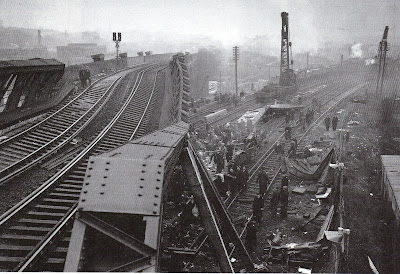
The scene from the wrecked bridge, looking south , on Friday 6 December after the engine of the Ramsgate train had been removed. A further disaster was averted on 4 December when the driver of a train approaching on the left-hand track over the bridge saw the leaning girders and stopped his train. It ran on to the bridge and was leaning but did not derail. All passengers were safely evacuated.
Action taken
Like many inquiries at this period into accidents caused by drivers passing signals at danger, the inspecting officer recommended the adoption of the warning type of automatic train control, today called the automatic warning system (AWS).
Although the SR management had their reservations about AWS, it was eventually installed. However, the system has since been blamed for several accidents where repetitive cancellation by drivers acknowledging caution signals has led to accidental cancellation at red signals. British Rail tested a new system -automatic train protection (ATP) -which had the potential to prevent a train from running into danger. But with privatisation looming, the political will wasn't there, and after privatisation the willingness of the private sector to fund installations of such equipment is non-existant as its not profitable.
Wednesday, 14 November 2007
Thirsk 2nd November 1892
Thirsk, Manor House 2nd November 1892
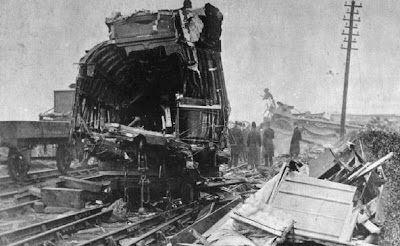
The fear that many men have of being seen to cry or show their fears has a large part to play in this story. This, together with a total lack of sensitivity on the part of the secondary players in the drama, a fear of the Company and a fear of causing delays to trains, brought about the Manor House crash.
James Holmes was 33 years old and had worked for the North Eastern Railway as a signalman since he joined the service in 1881. Since 1891 he had been working Manor House signal-box on the York to Darlington main line, three miles north of Thirsk and five miles south of Northallerton. It was a small, brick-built cabin on the up side of the line with seven levers to work distant, home and starting signals on the up and down main lines and a point lever for a short siding on the down side. The next signal-box to the north was Otterington, the next south was Avenue Junction, each roughly 1¼ miles away. He lived 2½ miles from the box with his wife and several children in a small house at the village of Thornton le Moor. Every day, twice a day, he walked through the lanes to work, come snow, rain or sun, on twelve hour shifts; he was happy enough, for the hours were no longer than in any other job and, after the walk, he was in the warm and the dry and his pay of 20 shillings a week was above average for that area and it was regular.
Sunday 30th October 1892 was his day off and he rested so well that he spent all Monday working in his orchard picking apples for market before walking to the signal-box for the twelve hour night shift. Between 18:00 and 06:00, James Holmes signaled about 95 trains including several very important expresses such as the Up Scotsman with Pullman cars. At 06:00 he was relieved by his mate, but he waited until the signalman from Avenue Junction arrived at Manor House so they could both walk home to Thornton together. He arrived at home at about 07:15,
put his bag in the kitchen and began to clear the ashes from the fire to relight it, and while he was doing this his wife came in to say that their youngest daughter, Rosy, who had been unwell for several days was decidedly unwell and was breathing heavily. James said “ I will go to bed now, put her in with me. You get Teddy off to school, see to the other children and when you've done bring me some tea and a bite to eat.” Two hours later, Mrs Holmes brought James his breakfast; he ate and fell asleep at 09:30. Two and a half hours later he was shocked out of a deep sleep by his wife, shaking him and shouting “Jim, Jim, Rosys in a fit!” James tumbled out of bed and told his wife to fetch a neighbour, an older woman. This worthy took one look at the child and said she needed a doctor. The doctor lived in Northallerton, five miles away. James Holmes walked and ran the mile to Otterington Station, got a lift on the down goods train and hurried to the doctors house only to be told that he had gone out on his rounds - including calls in Thornton le Moor. James went to the pub, had a half and a sandwich, and then set out on the long walk home, hoping to meet the doctor on the way. He did not see him. He arrived home to find his wife in tears and their daughter Rosy dead.
Mrs Holmes was devastated and could not be left alone, James was shocked and physically exhausted. He had had 2½ hours sleep in the previous 29 hours, he had walked nine miles since 06:00 that morning and that on very little food. He now set out to walk the mile or so to Otterington station to send a telegram to his mother in York, to ask her to come to Thornton. He also intended to ask his Inspector, based in Northallerton, to relieve him of duty on the approaching nightshift. He sent his telegram to York and asked his Station Master, Mr Kirby, to arrange relief for him that night “ as I have just had a child die very sudden and Im in bad fettle for work”. There must be times when the English “stiff upper lip” is a bad thing. This was such an occasion. Mr Kirby was unimpressed by James child dying and said that he would do what he could with the Northallerton Inspector but that he, James, must go home, prepare for work and return to the station later to see if he had been relieved or not. James Holmes walked another mile home.
He returned to Otterington station at 19:30, having slept for only 2½ hours in the preceeding 35 hours. Station Master Kirby may not have known this, but he knew James was tired and distressed,“in bad fettle for work”. When he told him that he could not be relieved, James said: "its a bad job. I shouldn't care so much for myself, I am most bothered about my wife". James would reveal his true feelings no more than that, while Kirby, scared of having delays to trains set at his door, did not suggest the obvious solution, that of switching Manor House box out of
circuit. Before James set out for the walk along the track to work, he spoke with the signalman in Otterington box, saying:“Harry, I am about done up for work. I never been off my legs since 12 oclock. I had to walk from Northallerton and twice to Otterington and back”. Never did he utter the precise words "I am unfit for work", and this was used later against him. He gave all kinds of warnings - his very appearance should have been enough - but neither he nor anyone else wanted to stand firm and refuse to work.
He worked well for the first part of the shift and by 03:40 on the 2nd November was actually priding himself on how well he was bearing up. By that time he had been awake and working hard for 48 hours with only 2½ hours sleep. The night was cold with patchy fog and the trains were running seven or eight an hour, one passing the box every 8½ or 9 minutes. The up Scotsman that night was running in two parts with a goods train in between them.
The first part of the express ran past the box at 03:38; James gave it “On line” to his mate at Avenue Junction, sent “Line clear” (corresponding to “Train out of section” in more modern times) to Otterington and put his signals to danger behind the express. It was at this point that the stamina of James Holmes ran out. No sooner than he had sat down in his chair, he was instantly asleep. Not ordinary sleep, but the deep sleep of an exhausted man. Some may have experience of it, a strange sleep where things like bell codes still have the power to command reflex actions from a man. Harry Eden in Otterington box rang “Call Attention” for the goods train, James got out of his chair, gave the road and went back to sleep. He in all probability never woke while he was working his instruments.
The goods train driver found Manor House signals against him and came to a stand at the home signal at 03:51. He did not blow his whistle and James Holmes slept on. Harry Eden was reading by his fire when he received “Train on line” for the second part of the Scotch express at 04:00. Only then did he see his instruments for the section to Manor House were still showing “Train on line” for the goods train. The North Eastern Railway block signaling regulation allowed Harry to send the "Be Ready" signal to James Holmes at Manor House box even though the instrument showed the line was occupied (“Be Ready” was the equivalent of “Is line clear?”). The bellcode woke James Holmes who, hearing the express passenger code and seeing that he still had “Train on line” showing on his instrument, came to the instant conclusion that he had omitted to clear the instrument after the passing of the first part of the Scotch express. He had not entered the goods train in his register and had no recollection of it in his confused and exhausted state.
James at once gave "Line clear" from Avenue Junction and lowered his up line signals. After a minute or so, the goods train, which had been waiting in silence at the home signal for ten minutes, started off with a gentle chuff and a creaking of couplings. Meanwhile, the second part of the Scotch express, 13 coaches hauled by 2-4-0 No 178, went through Otterington at 55-60 mph on the dead straight, slightly falling gradient. James Holmes was now doubly confused. He heard the goods train starting and telephoned Harry Eden. “Is this the express passenger you
have asked?“ He said, and put the phone down. Eden was puzzled and went to his window, looking up the line towards Manor House. The sound of the crash came dully through the intervening mile and a quarter in spite of the fog.
The driver and fireman of No 178 were Roland Ewart and Edward Head. The train was a heavy one, and both locomotive and the fireman were taking a pounding as the driver did his best to keep time. At times, the fog was so thick that the driver was unable to see a signal until he was "on top of it"; at other times, such as when approaching Manor House distant signal, he saw it at a range of 50 yards. The fireman, stoking continuously on the small, overloaded engine , took no part in the signal business, placing his trust, indeed his life, in the steel nerves of Driver Ewart who took his train into an impenetrable wall of fog at 60 mph, trusting in the signalling. All this just to adhere to the timetable.
Driver Ewart saw the red triangle of lights on the rear of the goods train brake van at a range of 50 yards. He had no time to brake and the next thing he knew he was waking up, in mortal pain, on his back on the frost covered grass of a field 60 feet from the line-side. One thigh was smashed, his ribs broken. The conductor from the Pullman car „India„ found him and gave him some brandy, and together they watched as the first small, flickering flames grew to engulf the wreckage of the train. Fireman Head woke in the same field, utterly at a loss to know how he
got there. Physically uninjured, he staggered to his feet and set out to protect the rear of his train, but woke again in a farmhouse kitchen. He was taken to Northallerton hospital. Signalman James Holmes was so utterly devastated by what he had done that uninjured passengers coming to the signal box to see if there was space there for the wounded had to console him. One eye-witness said that if it had not been for the "sweet kindness" of one lady, he, the witness, firmly believed that Holmes would have lost his mind that night.
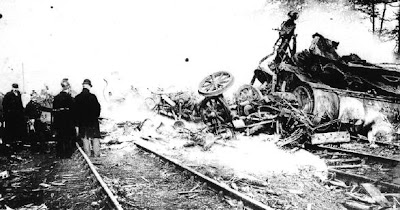
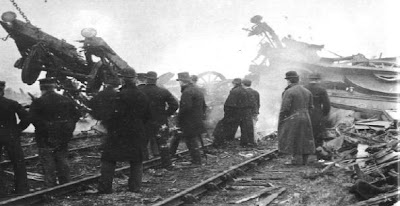
Ten people were killed, including George Petch, the guard of the goods train, and 39 were injured, trapped in the burning wreckage. Eight passenger carriages were destroyed, including the Pullman sleeping car „India„, and eight wagons from the goods train were lost. An inquest was held on the deceased and the jury's verdict was "culpable negligence" on the part of Holmes, "but we are convinced that if Holmes had been relieved when he so urgently appealed this would not have happened and the persons really responsible for the deaths are the Directors
of the North Eastern Railway". This verdict must be a classic case of „running with the hare and hunting with the hounds„ and although the "persons really responsible for the deaths were the Directors of the North Eastern Railway", it was James Holmes who stood trial for the manslaughter of George Petch.
There was a great deal of public sympathy for James, and while letters to The Times castigated the North Eastern Railway Directors, James and his family were recovering somewhat from the shocks they had suffered in the Sussex home of Henry Farmer-Atkinson, MP for Boston, who had invited them with their children. The trial was set for the 2nd of December 1892 at York Assizes. The judge was on the side of James Holmes - as far as he could make that plain - and warned the jury that „manslaughter„ is a very difficult thing to prove and every case has to be judged on its merits, but the essence was "causing the death of another by gross or culpable negligence, and Holmes had a great sorrow on him at the time and was not himself, he was distressed and tired".
Many searching questions were put to Station Master Kirby and to District Inspector Pick by the defense counsel.
“Why did you not give Holmes a companion in the box - a porter, say, from Otterington?”
“Why did you not switch the box out?”
“Why did you not realise the seriousness of Holmes condition after his protests at having to work?”
“Why were there no relief signalman to take his place in the box?”
In reply to the last question it was revealed that the North Eastern Railway considered that 17 relief men for over 300 signalmen was an entirely reasonable provision. The verdict of the jury was that James Holmes was guilty of the manslaughter of George Petch but added a very strong plea for mercy. The learned jidge, in passing sentence, said that this was the only verdict that could be brought. However, he evidently felt the mood of the time because he then said to Holmes. “I do not want to add to your troubles - you have suffered a great deal already. I bind you over for 12 months in the sum of £50 pounds”.
The fear that many men have of being seen to cry or show their fears has a large part to play in this story. This, together with a total lack of sensitivity on the part of the secondary players in the drama, a fear of the Company and a fear of causing delays to trains, brought about the Manor House crash.
James Holmes was 33 years old and had worked for the North Eastern Railway as a signalman since he joined the service in 1881. Since 1891 he had been working Manor House signal-box on the York to Darlington main line, three miles north of Thirsk and five miles south of Northallerton. It was a small, brick-built cabin on the up side of the line with seven levers to work distant, home and starting signals on the up and down main lines and a point lever for a short siding on the down side. The next signal-box to the north was Otterington, the next south was Avenue Junction, each roughly 1¼ miles away. He lived 2½ miles from the box with his wife and several children in a small house at the village of Thornton le Moor. Every day, twice a day, he walked through the lanes to work, come snow, rain or sun, on twelve hour shifts; he was happy enough, for the hours were no longer than in any other job and, after the walk, he was in the warm and the dry and his pay of 20 shillings a week was above average for that area and it was regular.
Sunday 30th October 1892 was his day off and he rested so well that he spent all Monday working in his orchard picking apples for market before walking to the signal-box for the twelve hour night shift. Between 18:00 and 06:00, James Holmes signaled about 95 trains including several very important expresses such as the Up Scotsman with Pullman cars. At 06:00 he was relieved by his mate, but he waited until the signalman from Avenue Junction arrived at Manor House so they could both walk home to Thornton together. He arrived at home at about 07:15,
put his bag in the kitchen and began to clear the ashes from the fire to relight it, and while he was doing this his wife came in to say that their youngest daughter, Rosy, who had been unwell for several days was decidedly unwell and was breathing heavily. James said “ I will go to bed now, put her in with me. You get Teddy off to school, see to the other children and when you've done bring me some tea and a bite to eat.” Two hours later, Mrs Holmes brought James his breakfast; he ate and fell asleep at 09:30. Two and a half hours later he was shocked out of a deep sleep by his wife, shaking him and shouting “Jim, Jim, Rosys in a fit!” James tumbled out of bed and told his wife to fetch a neighbour, an older woman. This worthy took one look at the child and said she needed a doctor. The doctor lived in Northallerton, five miles away. James Holmes walked and ran the mile to Otterington Station, got a lift on the down goods train and hurried to the doctors house only to be told that he had gone out on his rounds - including calls in Thornton le Moor. James went to the pub, had a half and a sandwich, and then set out on the long walk home, hoping to meet the doctor on the way. He did not see him. He arrived home to find his wife in tears and their daughter Rosy dead.
Mrs Holmes was devastated and could not be left alone, James was shocked and physically exhausted. He had had 2½ hours sleep in the previous 29 hours, he had walked nine miles since 06:00 that morning and that on very little food. He now set out to walk the mile or so to Otterington station to send a telegram to his mother in York, to ask her to come to Thornton. He also intended to ask his Inspector, based in Northallerton, to relieve him of duty on the approaching nightshift. He sent his telegram to York and asked his Station Master, Mr Kirby, to arrange relief for him that night “ as I have just had a child die very sudden and Im in bad fettle for work”. There must be times when the English “stiff upper lip” is a bad thing. This was such an occasion. Mr Kirby was unimpressed by James child dying and said that he would do what he could with the Northallerton Inspector but that he, James, must go home, prepare for work and return to the station later to see if he had been relieved or not. James Holmes walked another mile home.
He returned to Otterington station at 19:30, having slept for only 2½ hours in the preceeding 35 hours. Station Master Kirby may not have known this, but he knew James was tired and distressed,“in bad fettle for work”. When he told him that he could not be relieved, James said: "its a bad job. I shouldn't care so much for myself, I am most bothered about my wife". James would reveal his true feelings no more than that, while Kirby, scared of having delays to trains set at his door, did not suggest the obvious solution, that of switching Manor House box out of
circuit. Before James set out for the walk along the track to work, he spoke with the signalman in Otterington box, saying:“Harry, I am about done up for work. I never been off my legs since 12 oclock. I had to walk from Northallerton and twice to Otterington and back”. Never did he utter the precise words "I am unfit for work", and this was used later against him. He gave all kinds of warnings - his very appearance should have been enough - but neither he nor anyone else wanted to stand firm and refuse to work.
He worked well for the first part of the shift and by 03:40 on the 2nd November was actually priding himself on how well he was bearing up. By that time he had been awake and working hard for 48 hours with only 2½ hours sleep. The night was cold with patchy fog and the trains were running seven or eight an hour, one passing the box every 8½ or 9 minutes. The up Scotsman that night was running in two parts with a goods train in between them.
The first part of the express ran past the box at 03:38; James gave it “On line” to his mate at Avenue Junction, sent “Line clear” (corresponding to “Train out of section” in more modern times) to Otterington and put his signals to danger behind the express. It was at this point that the stamina of James Holmes ran out. No sooner than he had sat down in his chair, he was instantly asleep. Not ordinary sleep, but the deep sleep of an exhausted man. Some may have experience of it, a strange sleep where things like bell codes still have the power to command reflex actions from a man. Harry Eden in Otterington box rang “Call Attention” for the goods train, James got out of his chair, gave the road and went back to sleep. He in all probability never woke while he was working his instruments.
The goods train driver found Manor House signals against him and came to a stand at the home signal at 03:51. He did not blow his whistle and James Holmes slept on. Harry Eden was reading by his fire when he received “Train on line” for the second part of the Scotch express at 04:00. Only then did he see his instruments for the section to Manor House were still showing “Train on line” for the goods train. The North Eastern Railway block signaling regulation allowed Harry to send the "Be Ready" signal to James Holmes at Manor House box even though the instrument showed the line was occupied (“Be Ready” was the equivalent of “Is line clear?”). The bellcode woke James Holmes who, hearing the express passenger code and seeing that he still had “Train on line” showing on his instrument, came to the instant conclusion that he had omitted to clear the instrument after the passing of the first part of the Scotch express. He had not entered the goods train in his register and had no recollection of it in his confused and exhausted state.
James at once gave "Line clear" from Avenue Junction and lowered his up line signals. After a minute or so, the goods train, which had been waiting in silence at the home signal for ten minutes, started off with a gentle chuff and a creaking of couplings. Meanwhile, the second part of the Scotch express, 13 coaches hauled by 2-4-0 No 178, went through Otterington at 55-60 mph on the dead straight, slightly falling gradient. James Holmes was now doubly confused. He heard the goods train starting and telephoned Harry Eden. “Is this the express passenger you
have asked?“ He said, and put the phone down. Eden was puzzled and went to his window, looking up the line towards Manor House. The sound of the crash came dully through the intervening mile and a quarter in spite of the fog.
The driver and fireman of No 178 were Roland Ewart and Edward Head. The train was a heavy one, and both locomotive and the fireman were taking a pounding as the driver did his best to keep time. At times, the fog was so thick that the driver was unable to see a signal until he was "on top of it"; at other times, such as when approaching Manor House distant signal, he saw it at a range of 50 yards. The fireman, stoking continuously on the small, overloaded engine , took no part in the signal business, placing his trust, indeed his life, in the steel nerves of Driver Ewart who took his train into an impenetrable wall of fog at 60 mph, trusting in the signalling. All this just to adhere to the timetable.
Driver Ewart saw the red triangle of lights on the rear of the goods train brake van at a range of 50 yards. He had no time to brake and the next thing he knew he was waking up, in mortal pain, on his back on the frost covered grass of a field 60 feet from the line-side. One thigh was smashed, his ribs broken. The conductor from the Pullman car „India„ found him and gave him some brandy, and together they watched as the first small, flickering flames grew to engulf the wreckage of the train. Fireman Head woke in the same field, utterly at a loss to know how he
got there. Physically uninjured, he staggered to his feet and set out to protect the rear of his train, but woke again in a farmhouse kitchen. He was taken to Northallerton hospital. Signalman James Holmes was so utterly devastated by what he had done that uninjured passengers coming to the signal box to see if there was space there for the wounded had to console him. One eye-witness said that if it had not been for the "sweet kindness" of one lady, he, the witness, firmly believed that Holmes would have lost his mind that night.
Ten people were killed, including George Petch, the guard of the goods train, and 39 were injured, trapped in the burning wreckage. Eight passenger carriages were destroyed, including the Pullman sleeping car „India„, and eight wagons from the goods train were lost. An inquest was held on the deceased and the jury's verdict was "culpable negligence" on the part of Holmes, "but we are convinced that if Holmes had been relieved when he so urgently appealed this would not have happened and the persons really responsible for the deaths are the Directors
of the North Eastern Railway". This verdict must be a classic case of „running with the hare and hunting with the hounds„ and although the "persons really responsible for the deaths were the Directors of the North Eastern Railway", it was James Holmes who stood trial for the manslaughter of George Petch.
There was a great deal of public sympathy for James, and while letters to The Times castigated the North Eastern Railway Directors, James and his family were recovering somewhat from the shocks they had suffered in the Sussex home of Henry Farmer-Atkinson, MP for Boston, who had invited them with their children. The trial was set for the 2nd of December 1892 at York Assizes. The judge was on the side of James Holmes - as far as he could make that plain - and warned the jury that „manslaughter„ is a very difficult thing to prove and every case has to be judged on its merits, but the essence was "causing the death of another by gross or culpable negligence, and Holmes had a great sorrow on him at the time and was not himself, he was distressed and tired".
Many searching questions were put to Station Master Kirby and to District Inspector Pick by the defense counsel.
“Why did you not give Holmes a companion in the box - a porter, say, from Otterington?”
“Why did you not switch the box out?”
“Why did you not realise the seriousness of Holmes condition after his protests at having to work?”
“Why were there no relief signalman to take his place in the box?”
In reply to the last question it was revealed that the North Eastern Railway considered that 17 relief men for over 300 signalmen was an entirely reasonable provision. The verdict of the jury was that James Holmes was guilty of the manslaughter of George Petch but added a very strong plea for mercy. The learned jidge, in passing sentence, said that this was the only verdict that could be brought. However, he evidently felt the mood of the time because he then said to Holmes. “I do not want to add to your troubles - you have suffered a great deal already. I bind you over for 12 months in the sum of £50 pounds”.
Subscribe to:
Posts (Atom)